The Echoes Bible Story Part 2: The Challenge

Updated: Sep 21
Was the pattern discovered by David Pitcher truly meaningful, or had he simply stumbled upon some odd coincidence? With that lingering question in his mind, he walked through the doors of his Bible classroom the following week and took his seat.
He opened his Greek New Testament to the book of 2 Timothy, his Septuagint to the book of Numbers, and pulled out his notes to review them once more.
“What are you doing, David?” a voice asked from one row back.
David turned and saw a man known to be one of the brightest students in the class—a Messianic Jew who, like David, had arrived a bit early that day.
“Well,” David replied, “this past week I’ve been working on an experimental mapping between the book of 2 Timothy and the book of Numbers, based on sequential keywords I’m finding in both books.”
The man continued to look at David without speaking. David waited for a response, expecting a question. Instead, he heard something completely unexpected.
“I know who Jannes and Jambres are,” the man said.
David was being challenged.
When David reached this point in the story, as we sat together in the tiny lobby of a small hotel in the Old City of Jerusalem, he could tell by the look on my face that I would need some explanation. So he jumped right in.
“Jannes and Jambres have been the subject of a lot of speculation,” he said, “because they’re mentioned only once in the entire Bible—by Paul in 2 Timothy.”
Paul warns Timothy that in the last days men will arise who should be avoided if at all possible. Though they appear to have a form of godliness, inwardly they oppose the truth. Paul then cites two men as examples:
“Just as Jannes and Jambres opposed Moses, so these men also oppose the truth, men of depraved mind, rejected in regard to the faith. But they will not make further progress; for their folly will be obvious to all, just as Jannes and Jambres folly was also.” 2 Timothy 3:8-9.
Many have speculated that Jannes and Jambres were Egyptian priests who opposed Moses during the Exodus from Egypt. David had never given the matter much thought. The topic had not yet come up in class—they had not reached chapter 3—and he only vaguely remembered those names appearing in the text.
“Remind me,” David asked, reaching for his handwritten notes, “what chapter and verse is that in 2 Timothy?”
“Chapter 3, verse 8.”
“Hmmm,” David said slowly. “My mapping of 2 Timothy to Numbers would put chapter 3, verse 8… somewhere between chapter 22… and chapter 24.”
The man’s mouth fell open.
“How did you know?” he said. “In Jewish tradition, Jannes and Jambres are the servants of Balaam. And while they don’t appear by name in the Hebrew Bible, they are mentioned exactly once—in Numbers, chapter 22, verse 22.”
“Now he [Balaam] was riding on his donkey and his two servants were with him,” Numbers 22:22. (NASB)
David told me that a moment of awe settled over them both as they tried to take in what might have just happened.
David’s Bible class on the Pastoral Epistles covered 1 Timothy, 2 Timothy, and Titus. The term pastoral is often used because Paul wrote these letters to individuals rather than to churches. Needless to say, David changed the topic of his class paper from the word seal to the entire mapping he had discovered between 2 Timothy and Numbers.
“Was the instructor skeptical of your work?” I asked.
“No, he was very supportive.”
“Was he a Messianic Jew as well?”
“No,” he said. “He was a white-haired Gentile Christian, just like me,” adding, “He has since gone on to be with the Lord.”
“So what did you do after making the discovery?”
“After the class was finished, I remember finding some time at home just to say ‘thank you’ to God. I think my prayer was something like, ‘Thank you, Lord, for giving your grace to me and allowing me to discover that there is a connection between 2 Timothy and Numbers!’”
“That’s a nice thing to do.”
“Yes,” David said, “and the funny thing was what God said back to me.”
“What was that?”
“He said, ‘You’re not done.’”
“God said to you that you’re not done? Like in an audible voice?”
“No—not audible, but very clear, and similar to the ways in which I knew He was speaking in the past.”
“So what did you do?”
“Well, first I waited to see if God had anything else to say—any hints or instructions—but nothing else came. So I started asking myself where I might look next. And it occurred to me that since I had just discovered a connection between 2 Timothy and a book of the Old Testament, maybe I should look at 1 Timothy.”
“Wow—and what happened next?”
“Well, I thought about how I made the connection in the first place,” David said. “It started because Paul had made a direct quote from the book of Numbers, and both of those verses were about halfway through their respective books. So I wondered whether there might be a similar situation in 1 Timothy—where Paul directly quotes a book of the Old Testament at roughly the same proportion of the way through both books.”
“And did you find one?” I asked.
“Yes, I did. In 1 Timothy 5:18, Paul directly quotes Deuteronomy 25:4: ‘You shall not muzzle the ox while he is threshing.’ So, with this potential clue in hand, I began to examine keywords in both books. And sure enough, I found a very similar pattern to the one I had discovered between 2 Timothy and Numbers.
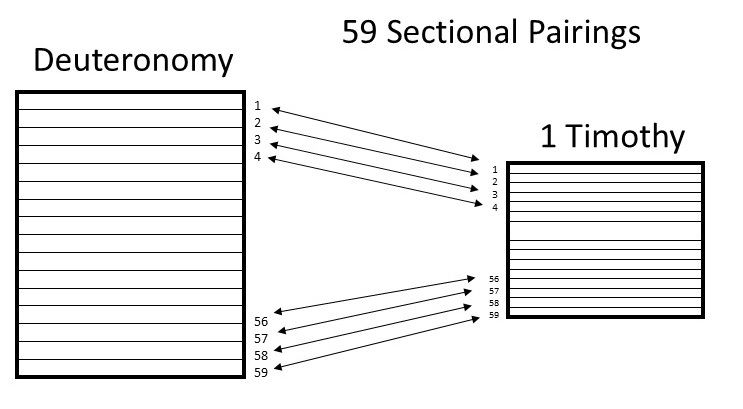
The story I was hearing was becoming more and more interesting.
David continued, “So after I got that one mapped out, I stopped and thanked God again for the grace to discover that there is a connection between 1 Timothy and Deuteronomy. Only this time, I added a question at the end of it.”
“Am I done?”
TO BE CONTINUED!
Click here to continue to part 3.

Wow! God is so facinating! This encourages me to press on in my Bible reading/dicovery journey. Thanks Echoes.